Before You Stitch Those Jeans: A Sewist's Guide to Denim That Can Actually Take a Beating
There's a moment in every jeans-making journey where ambition meets reality. You've traced the pattern, you've watched four topstitching tutorials, and then you walk into a fabric store — or open seventeen browser tabs — and freeze. Which bolt is the real deal? Which one will turn your dream jeans into a sad, baggy memory after three washes?
We asked the same question, then went looking for answers at independent fabric shops around the country, from a notions-packed storefront in Portland to a family-run denim supplier in the Carolinas. Here's what we learned, plus how five budget-friendly bolts actually performed.
What 'Jeans-Weight' Actually Means
Ask five shops what qualifies as jeans-weight and you'll get five slightly different answers — but they all orbit the same number. "When people say jeans-weight, I point them to 10 to 14 ounces per square yard," says one shop owner who stocks nothing but denim and twill. "Under 10 ounces and you're making shirts. Over 14 and your home machine is going to file a complaint."
Weight isn't the only spec that matters, though. Real jeans fabric has a few things going on:
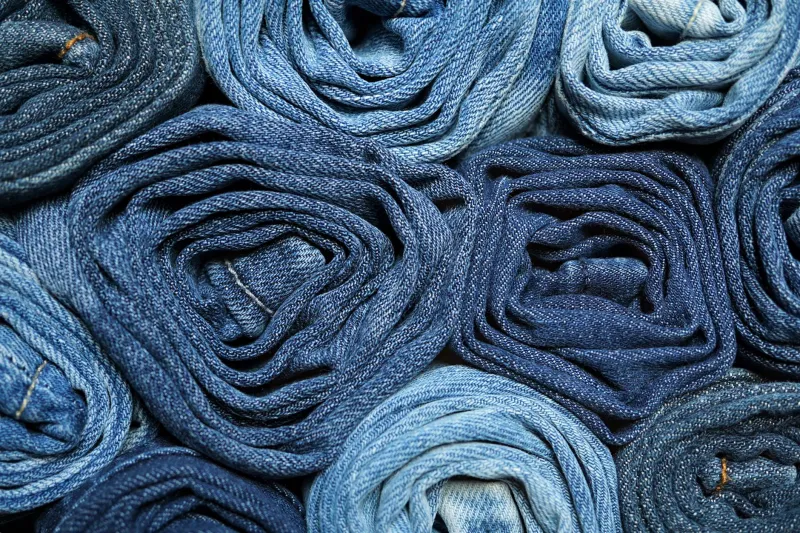
- Tight twill weave. That diagonal texture on denim's surface isn't decoration — it's structure. A tight 3x1 twill resists stretching and sagging where you need it to.
- Cotton with a little backbone. 100% cotton denim breaks in beautifully but can feel stiff at first. A touch of elastane (1–2%) adds comfort, though it can complicate topstitching.
- Selvage, or not. Selvage denim is the artisan darling — woven on old shuttle looms, finished on the edges. Lovely, but honestly? For your first pair, regular wide-width denim works fine and wastes less fabric.
The shop consensus: don't confuse denim with denim-look. Chambray, lightweight indigo cotton, and stretchy twill blends all photograph like jeans fabric online. In person, they behave like entirely different animals.
Five Bolts Under $25, Tested
We ordered five fabrics, all under $25 per yard, and put them through a mini gauntlet: a seam-puckering test, a wash-and-dry cycle, and yes, a pair of wearable test jeans for the two most promising contenders.
The 12 oz. indigo cone denim (~$18/yd): The workhorse. Sewed like a dream, faded at the knees exactly like good jeans should. Our top pick for first-timers.
The 10 oz. stretch twill (~$14/yd): Comfortable and forgiving, but the topstitching got wobbly around the 2% elastane. Great for a second pair once your skills are warmed up.
The 13 oz. raw cotton canvas (~$11/yd): Technically not denim, but it made a genuinely cool utility jean. Stiff out of the gate, softened by wash three.
The 8 oz. indigo chambray (~$12/yd): Beautiful fabric. Wrong project. Our test pockets sagged like laundry day. Save it for a shirt.
The 14 oz. heavyweight denim (~$24/yd): Gorgeous, authentic, and a genuine workout for our machine. Doable — with the tricks below — but not where we'd tell a beginner to start.
Sewing Through the Scary Seams
The moment that separates brave sewists from frustrated ones is the flat-felled seam over the yoke, where you're stitching through four to six layers of denim at once. Here's how the pros we spoke to handle it:
Hammer it. Seriously. Flatten bulky seams with a rubber mallet (or a regular hammer wrapped in cloth) before sewing. It crushes the fibers down and can halve the thickness you're feeding through.
Slow down and hand-crank. When you hit the thick spot, stop the machine and turn the handwheel manually. Your motor will thank you.
Use a jeans needle — the right one. A 100/16 jeans needle has a reinforced shaft that resists deflecting. Change it more often than you think you need to; a dull needle on denim is how skipped stitches happen.
Lengthen your stitches. A 3.0–3.5mm straight stitch on thick fabric. Shorter stitches just punch more holes into the same fibers.
Grade your seam allowances. Trim each layer of a bulky seam to a slightly different width so the layers don't stack up like a club sandwich.
Your Jeans Deserve It
Here's the thing: you're about to spend eight to twelve hours on a pair of jeans. You'll install a fly, wrestle with a waistband, and topstitch until your eyes cross. That investment deserves fabric that will still look good in two years.
A $12 chambray will get you a finished garment. A $18 jeans-weight twill will get you jeans — the kind that mold to your body, fade in all the right places, and make you want to tell strangers you made them. (You will anyway. We all do.)
Start with 10–12 ounces, trust your hands, and keep the mallet handy.