Meet Your Machine's Weird Little Parts: A Plain-English Tour From Frog Mouth to Feed Dogs
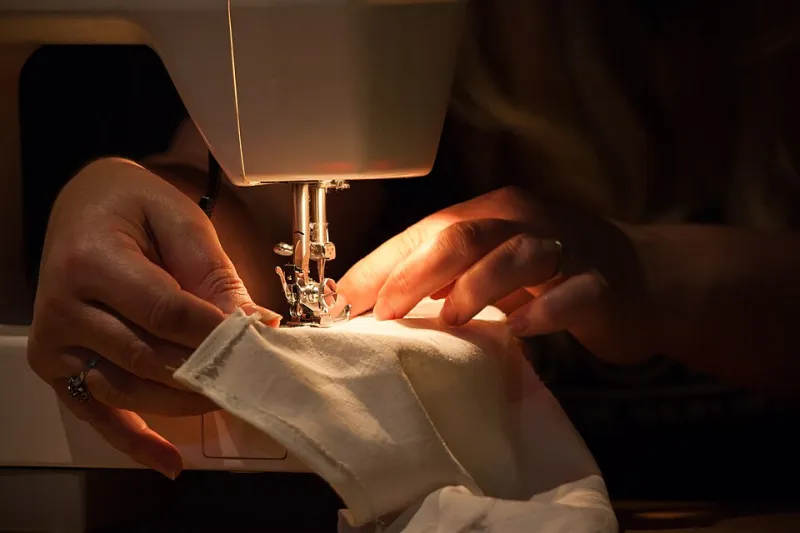
Photo: Tadeáš Bednarz, CC BY-SA 4.0, via Wikimedia Commons
Somewhere in your house right now, there's a small metal part called a frog mouth. There's also something called a feed dog, a stitch finger, and a race hook — and if you're like most sewists, you've been sewing for months (or years) without ever learning what any of them do.
That's not a character flaw. Most machines ship with a manual that reads like it was translated twice and photocopied in 1994, and the labeled diagram is usually a grainy black-and-white line drawing that looks more like a crime scene sketch than a helpful reference.
So let's do what we do around here: open the thing up, poke around, and figure out what's actually going on under that little plastic door. No jargon without a translation, and no part left unexplained.
First, the Part You've Definitely Met: The Frog Mouth
Open the bobbin cover on almost any modern machine and you'll see two curved metal plates that meet in the middle like open jaws. That's the frog mouth — the official (yes, official) name for the opening where the needle passes through to the bobbin area.
What it does: it holds your fabric flat and steady right at the point of stitching. When you slide fabric under the presser foot and it feels like the machine is "gripping" it, that's the frog mouth doing its job.
When you'll touch it: every time you sew, whether you realize it or not. It's also the part that collects lint like nobody's business, so it's the first stop on any cleaning routine. A soft brush (not canned air — that blasts lint deeper) takes care of it in thirty seconds.
Feed Dogs: The Tiny Teeth That Drive Everything
Look inside the frog mouth and you'll see two rows of small, serrated metal teeth. Those are the feed dogs, and they're the reason your fabric moves at all. They grip the underside of your fabric and pull it along in perfect rhythm with the needle — up, grip, forward, drop, repeat, several times per stitch.
When you'll touch them:
- Free-motion quilting or darning? You'll drop them (most machines have a switch or a setting) so you control the fabric movement instead.
- Skipping stitches or fabric not feeding? Lint-packed feed dogs are the number one culprit. Brush them out.
- Sewing on delicate fabric? A darning plate or lowered feed dogs can stop the machine from eating chiffon.
If your machine has a setting to lower them and you've never used it, congratulations — you now have a whole new skill unlocked.
The Stitch Plate (a.k.a. Throat Plate): Your Seam's Straightedge
The stitch plate is the flat metal plate surrounding the needle opening, usually etched with guide lines marking seam allowances — 1/4", 5/8", and so on. Those lines are your built-in ruler, and honestly, more sewists should stare at them.
When you'll touch it: when you swap it for a straight-stitch plate (a favorite trick for perfect topstitching on quilts), when you clean out lint, or — carefully — when a broken needle tip embeds itself in a needle hole. Yes, that happens. Keep tweezers nearby.
Bobbin Case and Race Hook: Where the Magic Actually Happens
Every stitch your machine makes is two threads locking together, and that lock happens under the stitch plate. The bobbin case holds the bobbin; the race hook (or rotary hook) spins around it, catching the needle thread and looping it around the bobbin thread.
When you'll touch it: whenever you wind a bobbin, obviously — but also when you get the dreaded bird's nest of thread underneath your fabric. Nine times out of ten, that mess means the machine wasn't threaded right, not that the bobbin area failed. Still, pop out the bobbin case, brush everything out, and rethread from scratch. It fixes more "broken machines" than any repair shop ever will.
One warning: if your machine has adjustable screws on the bobbin case, leave them alone unless you've got a manual and a steady hand. That's your bobbin tension, and it's a one-way ticket to Frustration Town if you fiddle blindly.
The Take-Up Lever: The Part Everyone Forgets
Up on the front of the machine, sometimes hidden behind a slot, is the take-up lever — the arm that rises and falls as the needle moves, pulling each thread loop tight and feeding thread off the spool.
Here's the thing most beginners miss: when you thread the machine, the take-up lever needs to be at its highest point. That's why the instructions always say to turn the hand wheel toward you until the needle is all the way up. Thread with the lever down and your thread will pop loose within a few stitches.
Tension Dials: Scary Name, Simple Idea
The tension dial on top of the machine controls how much the upper thread is pulled against the bobbin thread. Balanced tension means your stitches look identical on both sides of the fabric.
When you'll touch it: less often than you think. If your stitches are loopy on the bottom, the problem is almost always the upper thread path (rethread it), not the dial itself. Only adjust tension in small increments — think one number at a time — and write down the original setting first.
Quick-Reference Cheat Sheet
Tape this next to your machine:
- Frog mouth — the needle opening; keeps fabric flat; clean it often
- Feed dogs — metal teeth that move the fabric; drop for free-motion, brush for lint
- Stitch plate — flat plate with seam-allowance guides; your built-in ruler
- Bobbin case — holds the bobbin; pop out and brush regularly
- Race hook — spins to catch the needle thread; don't adjust its screws
- Take-up lever — thread with it at the top, always
- Tension dial — adjust one number at a time; usually not the problem
You're Not Going to Break It
Here's the real takeaway: almost nothing on a home sewing machine is as fragile or mysterious as it looks. The parts you're allowed to touch — the frog mouth, feed dogs, bobbin case, stitch plate — are designed to be opened, brushed out, and reassembled by regular people in their pajamas. The parts you shouldn't touch are clearly screwed down and few and far between.
So the next time your machine makes a weird noise or your stitches go sideways, don't panic and don't assume it's broken. Lift that cover, meet the weird little residents inside, and show them who's boss. Your machine has been waiting for you to introduce yourself.