That Tissue Pattern Shredded Again? Here's How to Never Cut Into the Original
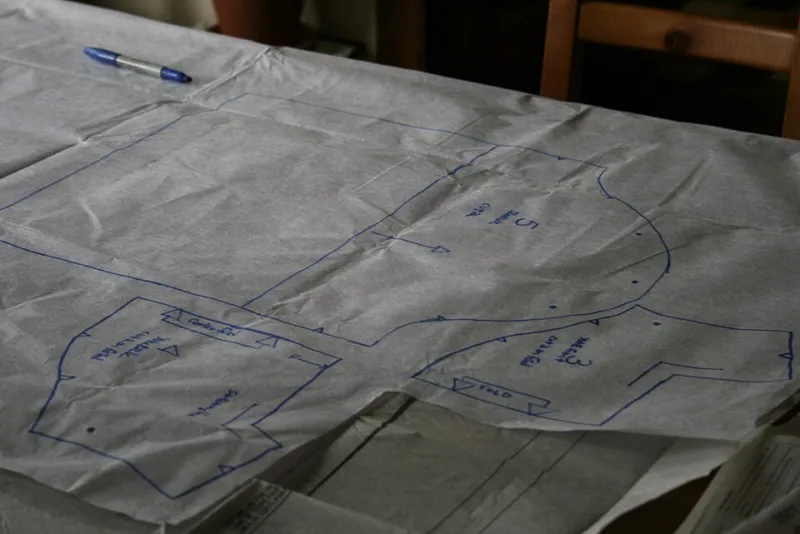
Photo: MissMessie, CC BY-SA 2.0, via Wikimedia Commons
Raise your hand if this sounds familiar: you finally settle on a pattern, you cut carefully, you sew the whole thing — and then you try to shove the tissue back into that too-small envelope. It doesn't fit. It never fit. And somewhere in the process, you've torn a ragged L-shape through the bodice piece.
Pattern tissue is a genuinely strange material. It's strong enough to survive printing and shipping across the country, but one snag on a pin and it's done. And here's the thing that really gets us: there's no good reason for it. This is a solved problem. We just haven't demanded better.
The Case Against Cutting the Original
Let's start with the core advice, because it's the whole game: stop cutting your tissue patterns.
Once you cut a pattern at a specific size, you've locked in that decision forever. Want to sew it again after your measurements shift? Or grade between sizes at the waist? You can't. The original is gone. Tracing off your size before cutting costs you maybe twenty minutes and preserves every option — including the option to sell or swap the pattern later.
The good news is you have more than one way to do this, and they range from basically free to a small investment that changes how you sew entirely.
Option 1: Freezer Paper — The $4 Workhorse
Yes, the same freezer paper from the grocery store aisle. It has a plastic coating on one side that lets you press it directly onto fabric with a dry iron, then peel it off cleanly.
How it works: trace your pattern pieces onto the paper side (the plastic goes down against the tissue or the fabric), cut out, and either use it as a template or iron it straight onto your fabric and cut around it. Because it clings, there's no pinning and no shifting.
Cost: About $4–6 for a roll that'll last you a couple of years.
Best for: Sewists on a budget, anyone who hates pinning, and smaller pattern pieces. The catch is that freezer paper can't go through a printer, and it doesn't hold up to repeated folding like sturdier materials.
Option 2: Swedish Tracing Paper — The Premium Pick
This is the stuff that feels like it was invented by someone who actually sews. It's a soft, semi-transparent nonwoven fabric-paper hybrid. You can trace onto it, sew it like a muslin to test fit, and it doesn't shred — ever.
The real magic: because you can baste it together and try it on, Swedish tracing paper lets you fit as you go before touching your good fabric. For garment sewing, that alone justifies the price.
Cost: Roughly $15–25 for a roll, depending on width.
Best for: Fitting-focused garment sewists and anyone building a long-term pattern library. If you sew more than a few garments a year, this pays for itself in saved fabric.
Option 3: Medical Exam Paper — The Underrated Middle Ground
Head to any pharmacy or grab it online: exam table paper rolls cost about the same as freezer paper but behave more like proper pattern paper. It's sturdy, takes pencil and tracing wheel marks beautifully, and stores flat without cracking.
Cost: $10–15 for a huge roll.
Best for: People who want durability without the Swedish tracing paper price tag. It won't survive sewing a test garment together, but it'll survive a decade in your pattern drawer.
Option 4: Projector Sewing — The Future, Already Here
Here's where it gets interesting. A growing corner of the sewing world has stopped printing and tracing entirely. Instead, they project the PDF pattern file directly onto their cutting mat — at full scale — and cut fabric with no paper involved at all.
The setup: a short-throw projector (used models start around $60–80), mounted above your cutting space, calibrated so the image projects at exactly 100% scale. Files are calibrated once, then every future pattern cuts out in minutes.
Cost: $60–150 to start, depending on how scrappy you are with the mount.
Best for: Anyone who sews frequently and is tired of the print-trace-cut loop entirely. The learning curve is real — calibration takes an afternoon — but the community around it (search "projector sewing groups") has made calibration files and guides free and abundant.
So Why Are Companies Still Printing on Tissue?
Honest answer: inertia and margins. Tissue is cheap, it folds small, and Big Envelope has worked this way since your grandmother bought her first Butterick. Some independent companies now print on durable paper or offer print-at-home and copy-shop PDFs, which helps — but the Big 4 still mostly ship the same fragile envelopes they did in 1985.
Our take: the technology to fix this exists, and some of it (projectors, print shops) is already in consumers' hands. Until the industry catches up, the smartest move is to treat every tissue pattern as a master copy — trace it, protect it, and never let scissors near the original.
Your Move
If you do nothing else after reading this: grab a roll of freezer paper this week and trace off the next pattern before you cut it. Twenty minutes now versus a shredded envelope later. Your future self — the one sewing that pattern a second time in a different size — will send her thanks.