Fifty Square Feet Is Plenty: How to Build a Sewing Corner You'll Actually Sit Down In
We asked our readers a few months back to send us photos of where they actually sew. Not the aspirational Pinterest boards — the real spots. Out of 214 submissions, exactly eleven had a dedicated craft room. The rest? A dining table that gets cleared every Thanksgiving. A basement corner next to the chest freezer. One woman in Ohio who sews on a TV tray because her kids monopolize the kitchen island.
And here's the thing: the sewists who finished the most projects weren't the ones with the biggest spaces. They were the ones whose spaces had the least friction — where sitting down to sew took thirty seconds instead of thirty minutes of setup. That's what this guide is about. Not decorating a studio. Engineering a corner that works.
The Real Enemy: Setup Time
If you have to drag your machine out of a closet, find your pedal, hunt for the good scissors, and wait for the iron to heat up, you'll sew maybe twice a month. Every one of those steps is a chance to say 'forget it' and watch TV instead.
So the whole philosophy of a working sewing corner comes down to one rule: everything you touch on every project stays within arm's reach of the chair.
The Three-Zone Layout
Whether you've got 50 square feet or 15, think of your space in three zones:
Zone 1: The Machine Zone. Your machine should live out in the open, uncovered, plugged in, with a bobbin wound. Yes, even in a living room. A dust cover is fine; a coffin-style storage cabinet that requires six steps to open is not. If your machine is out and threaded, you'll sew on a Tuesday night for twenty minutes. If it's packed away, you won't.
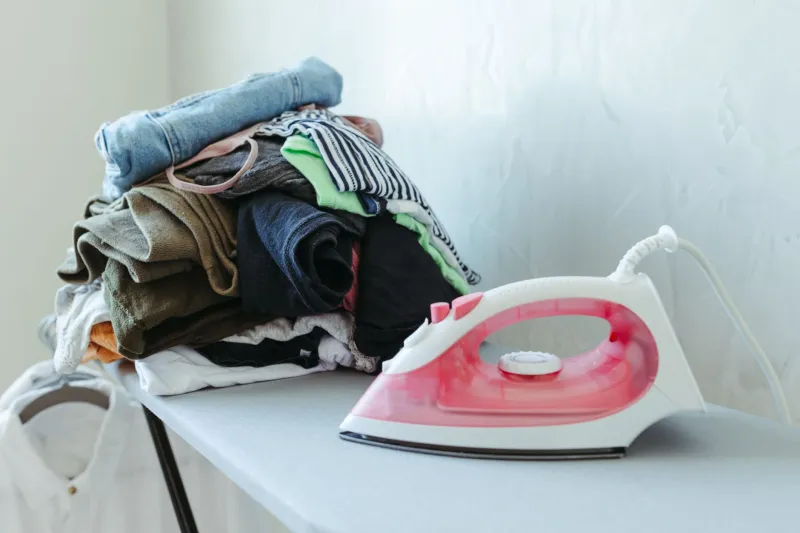
Zone 2: The Pressing Zone. This is the one everyone gets wrong. Your ironing board doesn't need to be fully set up all the time — but pressing is half of sewing, and walking to another room to press a seam every forty-five seconds will drive you to quitting. Solutions that work in small spaces:
- A tabletop ironing board or a wool pressing mat stored next to the machine
- A wall-mounted ironing board that folds flat (the Brabantia and Household Essentials wall-mount models run $60–$120)
- An over-the-door ironing board on the back of a nearby closet door
Zone 3: The Project Zone. One bin, basket, or clear tote per active project — fabric, pattern, notions, cut pieces, all of it together. When you're done sewing for the night, everything goes back in the bin. This single habit kills the 'where did I put that pattern piece' problem and keeps works-in-progress visible, which matters more than you'd think. Projects you can see get finished.
Three Reader Floor Plans That Actually Work
The Apartment Dining Corner (Maya, Portland, OR): Maya's machine lives on a small IKEA KALLAX-topped table in her dining room corner, with a rolling cart (the classic RÅSKOG, $40) holding tools in the top drawer, patterns in the middle, and stabilizer and interfacing below. Her ironing board hangs on the wall behind the door. Total footprint: about 4 by 5 feet.
The Basement Realist (Denise, Columbus, OH): Denise sews in an unfinished basement, so she spent her budget on light instead of furniture — two clip-on shop lights ($15 each) pointed at her work surface, because overhead bulbs cast shadows right where you're sewing. Her pressing station is a folded wool blanket on an old dresser top with a cheap iron that never leaves the spot. Her advice: 'Spend on light and chair, not on storage bins.'
The Shared-Space Compromise (Priya, suburban Chicago): With two kids and a partner who works from home, Priya's setup is a rolling sewing cart that lives in a hallway closet. The trick: it's a complete cart — machine, notions, pressing mat, small iron, and one project bin ride together. One trip out, one trip back. Setup time: under two minutes.
The Budget Breakdown
A functional corner doesn't require a shopping spree. Here's a realistic spend, mixing new and thrifted:
- Folding or secondhand table: $0–$50 (check Facebook Marketplace — sewing tables get given away constantly)
- Rolling utility cart: $30–$40
- Tabletop ironing board or wool mat: $15–$30
- Clear project bins (3-pack): $10
- Task lighting: $15–$25
That's a working sewing corner for somewhere between $70 and $155. Compare that to what we spend on fabric we haven't cut yet, and it's a bargain.
The One Thing to Do This Weekend
If you take nothing else from this: move your machine to where you spend your evenings, plug it in, and leave it there. That's it. Everything else — the pegboard, the labeled jars, the color-sorted thread — is optional. A messy corner you sew in beats a beautiful room you don't.
Got a small-space setup that works? Send us a photo. We're collecting round two of reader floor plans, and the TV tray sewists of the world deserve their recognition.